Download free PDF

Automotive Heat Exchanger Market Size & Share 2026-2035

Market Size - By Vehicle (Passenger Vehicles, Commercial Vehicles, Off-Highway Vehicles); By Product (Radiators, Intercoolers, Oil Coolers, Exhaust Gas Recirculation (EGR), Others); By Material (Aluminum, Copper, Others); By Design (Plate Bar, Tube Fin, Others); By Sales Channel (OEM, Aftermarket); By Propulsion (ICE, Electric, Hybrid), Growth Forecast. The market forecasts are provided in terms of value (USD) & shipment (Units).

Report ID: GMI13189
   |
Published Date: April 2026
 | 
Report Format: PDF

Download Free PDF

Automotive Heat Exchanger Market Size

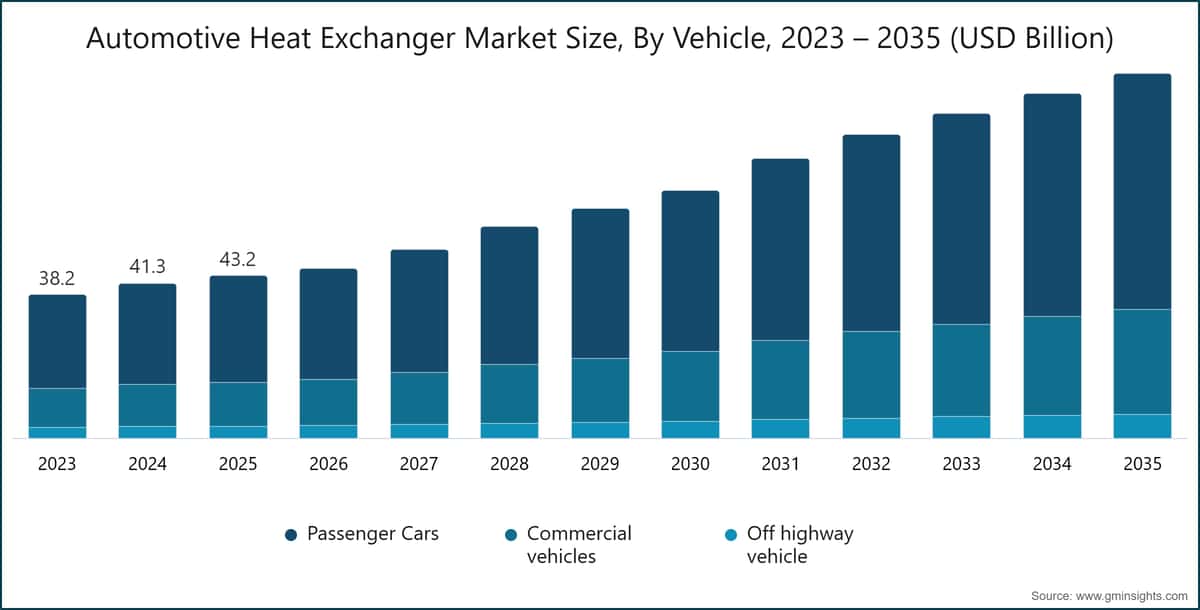
The global automotive heat exchanger market was estimated at USD 43.2 billion in 2025. The market is expected to grow from USD 45.3 billion in 2026 to USD 97.2 billion in 2035, at a CAGR of 8.9%, according to latest report published by Global Market Insights Inc.

Automotive Heat Exchanger Market Key Takeaways

Market Size & Growth

  • 2025 Market Size: USD 43.3 Billion
  • 2026 Market Size: USD 45.3 Billion
  • 2035 Forecast Market Size: USD 97.2 Billion
  • CAGR (2026–2035): 8.9%

Regional Dominance

  • Largest Market: Asia Pacific
  • Fastest Growing Region: Asia Pacific

Key Market Drivers

  • Growth of electric and hybrid vehicles.
  • Stringent emissions and fuel efficiency regulations.
  • Advancements in heat exchanger material.
  • Increasing vehicle production and demand.

Challenges

  • High material and manufacturing costs.
  • Complexity of thermal management systems.

Opportunity

  • Expansion of electric vehicle thermal management systems.
  • Adoption of advanced heat pump-based HVAC systems.
  • Integration of smart and connected thermal systems.
  • Growth in emerging markets and vehicle production.

Key Players

  • Market Leader: Denso led with over 13.8% market share in 2025.
  • Leading Players: Top 5 players in this market include Denso, Valeo, Mahle, Hanon Systems, Marelli, which collectively held a market share of 55.6% in 2025.

The market volume was estimated at 298.3 million units in 2025. The market is projected to grow from 320.4 million units in 2026 to 497.4 million units by 2035, registering strong double-digit growth over the forecast period.

The rapid evolution of the automotive industry driven by electrification, stricter emission standards, and the need for improved vehicle efficiency is significantly transforming the automotive heat exchanger market. Traditionally limited to engine cooling and basic HVAC applications in internal combustion engine (ICE) vehicles, heat exchangers are now becoming central to managing complex thermal loads across modern vehicles. In electric and hybrid vehicles, they play a critical role in regulating battery temperature, cooling power electronics, and maintaining optimal cabin conditions, thereby directly influencing vehicle performance, safety, and driving range.

Increasing consumer demand for enhanced comfort and premium in-vehicle experiences is further strengthening the importance of advanced thermal systems. Features such as automatic climate control, seat heating and cooling, and multi-zone HVAC systems are driving the integration of highly efficient and compact heat exchangers. At the same time, manufacturers are focusing on lightweight and high-performance materials such as aluminum and composite structures to improve heat transfer efficiency while reducing overall vehicle weight.

For instance, in March 2025, Valeo announced the expansion of its high-efficiency heat pump and thermal system production in Europe to support EV manufacturers in meeting stringent emission norms and improving vehicle range and cabin comfort.

The growing penetration of electric vehicles, along with tightening global emission and fuel efficiency regulations, is accelerating the demand for next-generation heat exchanger solutions. Automotive manufacturers are shifting toward integrated thermal architectures that combine multiple heat exchange functions into a single system. This approach enhances energy efficiency, reduces system complexity, and supports better thermal management across batteries, motors, and electronic components.

Innovation in materials and design is reshaping the competitive landscape of the market. Advanced technologies such as microchannel heat exchangers, compact brazed aluminum units, high-efficiency condensers and evaporators are gaining widespread adoption. In addition, the development of environmentally sustainable refrigerants with lower global warming potential (GWP) is becoming a priority due to evolving regulatory requirements. Companies are also investing in intelligent thermal management systems that leverage sensors and control algorithms to optimize temperature regulation in real time.

Electrification is also influencing heat exchanger requirements across different vehicle segments. Passenger electric vehicles increasingly rely on energy-efficient HVAC systems, including heat pump-based solutions, to enhance driving range under varying climatic conditions. In commercial vehicles and electric buses, heat exchangers are designed to handle higher thermal loads associated with large battery capacities and extended operational cycles. Furthermore, the shift toward high-voltage platforms and fast-charging infrastructure is increasing the need for advanced cooling technologies capable of maintaining thermal stability under high stress conditions.

Digital integration is emerging as a key trend in the automotive heat exchanger market. Modern thermal systems are increasingly connected with vehicle-wide control architectures, including battery management systems (BMS) and electronic control units (ECUs). Advanced software-driven thermal management enables predictive temperature control, pre-conditioning functions, and optimized energy distribution, enhancing both vehicle efficiency and safety. Compliance with global safety standards is also gaining importance, as effective thermal management is critical to preventing system failures and ensuring safe vehicle operation.

North America and Europe represent high-value markets for automotive heat exchangers, driven by stringent emission regulations, fuel efficiency standards, and advanced vehicle technologies. Strong OEM presence and electrification trends increase demand for compact, high-performance thermal systems. Focus on engine downsizing, cabin comfort, and battery efficiency further supports adoption of advanced heat exchanger solutions across passenger and commercial vehicles.

Asia-Pacific is the fastest-growing automotive heat exchanger market due to high vehicle production, rising electrification, and stricter emission norms. China leads demand with large-scale manufacturing, while India, Japan, and South Korea invest in cost-efficient and advanced thermal technologies. Growth in electric vehicles, two-wheelers, and commercial fleets is driving scalable, durable, and energy-efficient heat exchanger adoption across the region.

Automotive Heat Exchanger Market Research Report

Automotive Heat Exchanger Market Trends

Automakers are increasingly adopting integrated thermal management systems that combine multiple functions such as engine cooling, battery thermal regulation, and cabin HVAC into a single architecture. This trend reduces component redundancy, improves overall system efficiency, and optimizes energy usage. It is particularly important in electric vehicles, where coordinated thermal control directly impacts battery performance, driving range, and passenger comfort.

For instance, in May 2025, Mahle GmbH introduced an integrated thermal management module combining battery cooling, power electronics, and HVAC functions into a single compact unit, aimed at improving EV efficiency, reducing system complexity, and enhancing overall vehicle energy management.

Microchannel heat exchangers are becoming widely adopted due to their superior heat transfer capabilities and compact design. These systems use smaller channels to increase surface area, enabling efficient heat dissipation with reduced material usage. Their lightweight structure supports vehicle weight reduction goals while maintaining high thermal performance, making them highly suitable for modern vehicles with space constraints and efficiency requirements.

The shift toward lightweight vehicles is driving the adoption of advanced materials such as aluminum alloys, composites, and corrosion-resistant coatings in heat exchangers. These materials improve thermal conductivity, durability, and resistance to harsh operating conditions. By reducing overall system weight while maintaining performance, they contribute significantly to improved fuel efficiency in ICE vehicles and extended range in electric vehicles.

With the rapid growth of electric vehicles, there is increasing demand for specialized heat exchangers tailored for battery cooling, power electronics, and electric drivetrains. These solutions are designed to manage high thermal loads and maintain optimal operating temperatures. Effective thermal management enhances battery lifespan, improves charging efficiency, and ensures safety, making EV-specific heat exchangers a critical area of innovation.

Heat exchangers are increasingly being integrated with sensors and advanced control software, enabling intelligent thermal management. These systems monitor real-time temperature data and adjust cooling or heating dynamically based on operating conditions. Predictive algorithms and connectivity features enhance efficiency, reduce energy consumption, and improve reliability, supporting the broader trend toward connected and autonomous vehicle technologies.

Automotive Heat Exchanger Market Analysis
Chart: Automotive Heat Exchanger Market Size, By Vehicle, 2023 – 2035 (USD Billion)

Based on vehicle, the market is divided into passenger cars, commercial vehicles, and off highway vehicle. The passenger cars segment dominated the automotive heat exchanger market, accounting for around 65.5% in 2025 and is expected to grow at a CAGR of more than 8.7% through 2035.

  • The automotive heat exchanger industry is largely dominated by passenger cars, driven by the growing global demand for personal mobility, rising adoption of electric and hybrid vehicles, and increasing consumer expectations for comfort, safety, and energy efficiency. Passenger vehicles require efficient thermal management for engine cooling, battery performance, and HVAC systems to ensure optimal driving range, cabin comfort, and overall reliability.
  • Additionally, the focus on lightweight materials, compact designs, and advanced technologies such as microchannel heat exchangers and integrated thermal management systems further supports market growth in this segment. Continuous innovation by OEMs and suppliers to enhance energy efficiency, reduce emissions, and improve vehicle performance reinforces the dominance of passenger cars in the automotive heat exchanger industry.
  • For example, in February 2025, Denso Corporation introduced integrated battery cooling and HVAC heat exchanger systems for hybrid and electric passenger cars, enabling extended driving range, improved energy efficiency, and better cabin comfort.
  • The commercial vehicle segment is expected to experience a faster growth of more than 9.5% over the forecast period, driven by increasing demand for logistics and transportation services, expansion of urban delivery fleets, and growing adoption of electric and hybrid trucks and buses. Efficient thermal management systems are critical for engine performance, battery cooling, and HVAC in commercial vehicles.

    Automotive Heat Exchanger Market Revenue Share, By Sales Channel, (2025)

Based on sales channel, the market is categorized into OEM, and aftermarket. The OEM segment dominates the market accounting for around 72.2% share in 2025, and the segment is expected to grow at a CAGR of over 8.3% from 2026-2035.

  • The automotive heat exchanger market is primarily led by the OEM segment, as these systems are incorporated during vehicle design and assembly, ensuring efficient engine cooling, battery thermal management, and HVAC performance. OEMs prioritize high-quality heat exchangers to meet emission regulations, improve energy efficiency, and enhance overall vehicle reliability.
  • Furthermore, the adoption of advanced technologies such as lightweight materials, microchannel designs, and integrated thermal management by OEMs strengthens system performance and durability. Early integration during production minimizes aftermarket dependence, ensures compliance with regulatory standards, and delivers better vehicle performance and customer satisfaction, making OEMs the dominant revenue contributor in the automotive heat exchanger market.
  • For example, in July 2025, BorgWarner Inc. secured contracts with multiple global OEMs to supply high‑voltage coolant heater thermal systems for hybrid and EV platforms, reinforcing how OEMs integrate advanced heat exchangers early in vehicle design to improve battery and cabin thermal performance.
  • The Aftermarket segment is expected to grow with a CAGR of more than 10.2% due to increasing demand for replacement and maintenance of heat exchangers in aging vehicles, rising EV retrofitting, and growing awareness of efficient thermal system upkeep. Services such as coolant replacement, battery cooling module retrofit, and HVAC maintenance are driving segment growth. Additionally, expansion of vehicle ownership, extended vehicle lifespans, and stricter emission regulations are encouraging fleet operators and individual owners to invest in high-quality aftermarket thermal solutions.

Based on material, the automotive heat exchanger market is divided into aluminum, copper, and others. The Aluminum segment held the major market share in 2025. 

  • The Aluminum segment is the largest market segment in the market due to its lightweight, high thermal conductivity, corrosion resistance, and durability. Aluminum heat exchangers improve fuel efficiency in ICE vehicles and extend battery range in electric vehicles while supporting compact, efficient designs suitable for modern automotive platforms.
  • Additionally, aluminum enables the production of microchannel and multi-pass heat exchangers, enhancing heat transfer performance and reducing material usage. Its recyclability and compatibility with advanced manufacturing processes make it the preferred choice for OEMs and aftermarket suppliers. Growing demand for energy-efficient vehicles, lightweight components, and environmentally friendly materials further reinforces aluminum’s dominance in the automotive heat exchanger market.
  • For instance, in November 2025, Hanon Systems showcased its latest thermal management technologies, including aluminum heat exchanger modules, at the AAPEX 2025 expo, reinforcing its leadership in advanced cooling and HVAC solutions for both OEM and aftermarket applications.

Based on product, the automotive heat exchanger market is divided into radiators, intercoolers, oil coolers, exhaust gas recirculation (EGR), and others. The radiators segment dominated the market.

  • The radiators segment dominates the market due to their critical role in engine cooling, maintaining optimal operating temperatures, and preventing overheating in both ICE and hybrid vehicles. Radiators ensure engine efficiency, reliability, and longevity, making them essential in passenger cars, commercial vehicles, and EV platforms with thermal management needs.
  • Additionally, continuous advancements in radiator design, such as aluminum construction, microchannel technology, and compact modular systems, enhance heat transfer efficiency, reduce weight, and improve fuel economy. Growing vehicle production, rising adoption of electric and hybrid vehicles, and stricter emission standards further drive demand for high-performance radiators, solidifying their position as the largest and most essential segment in the automotive heat exchanger market.
  • In April 2024, MAHLE GmbH secured major orders for thermal management modules that include automotive radiators from global EV and hybrid manufacturers, reinforcing the ongoing importance of radiator cooling systems in both conventional and electrified vehicles.
  • The Intercoolers segment is expected to grow with a CAGR of more than 10.3% due to increasing adoption of turbocharged engines in passenger cars, commercial vehicles, and high-performance EVs. Intercoolers enhance engine efficiency, reduce air temperature intake, and improve power output, making them essential for modern internal combustion, hybrid, and electrified powertrains.

    China Automotive Heat Exchanger Market Size, 2023 – 2035, (USD Billion)

China dominated the automotive heat exchanger market in Asia Pacific with around 64.2% share and generated USD 11 billion in revenue in 2025.

  • China’s market is experiencing robust growth due to its dominant position in global vehicle production and rapid electrification across passenger and commercial segments. Strong government support through subsidies, emission regulations, and EV mandates is accelerating the adoption of advanced thermal systems. The country’s large-scale manufacturing ecosystem and presence of domestic OEMs are further driving demand for cost-efficient and high-performance heat exchangers.
  • In addition, China’s leadership in battery production and electric vehicle supply chains is increasing the need for specialized thermal management solutions such as battery cooling systems and heat pump-based HVAC technologies. Continuous investments in lightweight materials, localized component manufacturing, and innovation in thermal efficiency are supporting market expansion while enabling scalability and competitiveness in both domestic and export markets.
  • For instance, in March 2025, Ningbo Joyson Electronic announced the expansion of its heat exchanger manufacturing capacity to support rising EV production, reflecting strong domestic demand for efficient thermal management in battery electric and hybrid vehicles.
  • India is projected to grow at a significant CAGR in the automotive heat exchanger market due to the rapid adoption of electric vehicles, growing domestic automobile production, and government initiatives promoting cleaner and energy-efficient transportation. Rising demand for thermal management in passenger cars, commercial vehicles, and two- and three-wheelers is driving the need for advanced heat exchanger solutions.

The automotive heat exchanger market in Germany is expected to experience significant and promising growth from 2026 to 2035.

  • Europe accounts for over 20.1% of the market in 2025 and is expected to grow at a CAGR of around 7.8% due to stringent emission regulations, rapid adoption of electric and hybrid vehicles, and strong focus on energy-efficient thermal management systems. Automakers are investing in advanced heat exchangers to improve battery performance, cabin comfort, and overall vehicle efficiency across passenger and commercial segments.
  • Germany is a strong automotive heat exchanger market leader due to its large-scale automotive manufacturing ecosystem, presence of major OEMs, and strong focus on electric and hybrid vehicle development. The country’s stringent emission regulations and energy efficiency standards drive demand for advanced thermal management systems across passenger and commercial vehicles.
  • Continuous innovation in high-performance heat exchangers, including microchannel designs, lightweight aluminum materials, and integrated battery cooling solutions, further strengthens Germany’s market leadership. Investments in R&D, smart thermal management technologies, and collaboration between OEMs and suppliers ensure optimized vehicle performance, extended battery life, and enhanced cabin comfort, making Germany a key driver in Europe’s automotive heat exchanger industry.
  • For example, in September 2024, Behr Hella Service introduced microchannel aluminum heat exchangers with compact designs, offering improved heat transfer, reduced weight, and enhanced energy efficiency for both passenger and commercial vehicles.
  • The UK is emerging as a strong growth market for automotive heat exchangers due to increasing adoption of electric and hybrid vehicles, government incentives for clean mobility, and stringent emission and fuel efficiency regulations. Rising demand for efficient battery cooling and advanced HVAC systems is driving the market across passenger and commercial vehicles.

The automotive heat exchanger market in US is expected to experience significant and promising growth from 2026-2035.

  • North America accounts for over 28.7% of the market in 2025 and is expected to grow at a CAGR of around 9% between 2026 and 2035 owing to the rising adoption of electric and hybrid vehicles, stringent emission regulations, and increasing demand for energy-efficient thermal management systems. Advanced heat exchangers are essential for battery cooling, HVAC optimization, and drivetrain efficiency.
  • The US is the market leader in the automotive heat exchanger segment due to its advanced automotive manufacturing ecosystem, early adoption of electric and hybrid vehicles, and strict emission and fuel efficiency regulations. High consumer demand for EVs, premium passenger vehicles, and commercial fleets is driving the need for efficient thermal management systems that optimize battery performance, enhance cabin comfort, and maintain drivetrain reliability across diverse operating conditions.
  • In addition, strong R&D capabilities, presence of major OEMs, and continuous technological innovation in lightweight materials, microchannel heat exchangers, and integrated thermal systems strengthen the US market leadership. Investments in smart thermal management, predictive cooling, and eco-friendly refrigerants are further supporting efficiency improvements, extended EV range, and compliance with stringent environmental standards.
  • For example, in March 2025, Modine Manufacturing Company expanded its production of high-efficiency heat exchangers for electric and hybrid vehicles, supporting US OEMs in improving battery performance, vehicle efficiency, and cabin comfort amid growing EV adoption.
  • Canada is becoming one of the fastest-growing markets in the automotive heat exchanger sector due to increasing adoption of electric and hybrid vehicles, government incentives for clean mobility, and rising demand for energy-efficient thermal management systems in both passenger and commercial vehicles. The shift toward EVs is driving investment in advanced battery cooling and HVAC solutions.

The automotive heat exchanger market in Brazil is expected to experience significant and promising growth from 2026 to 2035.

  • Latin America holds around 7.2% of the market in 2025 and is growing steadily at a CAGR of around 6.9% between 2026 and 2035 due to increasing vehicle production, rising adoption of electric and hybrid vehicles, and growing regulatory focus on emission reduction and fuel efficiency. Automakers are investing in efficient thermal management systems to improve vehicle performance and passenger comfort.
  • Brazil dominates the automotive heat exchanger market in Latin America due to its large-scale automotive manufacturing industry, well-established OEMs, and significant domestic vehicle demand. The country’s focus on modernizing passenger and commercial vehicle fleets, along with increasing adoption of electric and hybrid vehicles, is driving strong demand for efficient thermal management systems. Heat exchangers play a critical role in engine cooling, battery thermal regulation, and HVAC optimization, ensuring vehicle performance, safety, and passenger comfort.
  • In addition, ongoing investments in lightweight and high-efficiency heat exchanger technologies, such as microchannel designs and aluminum-based components, support Brazil’s leadership in the regional market. Growing urbanization, modernization of logistics fleets, and government policies promoting fuel efficiency and emission reduction further reinforce the country’s dominance in Latin America’s automotive heat exchanger sector.
  • In March 2025, WEG Equipamentos Elétricos expanded production of automotive heat exchangers and thermal management systems to support leading Brazilian OEMs like Volkswagen, Fiat, and General Motors, enhancing engine cooling, battery efficiency, and HVAC performance in passenger and commercial vehicles.
  • The automotive heat exchanger market in Mexico is experiencing high growth due to increasing vehicle production, rising adoption of electric and hybrid vehicles, and government policies promoting cleaner and more energy-efficient transportation. Growing demand for efficient engine cooling, battery thermal management, and HVAC systems is driving market expansion across passenger and commercial vehicles.

The automotive heat exchanger market in UAE is expected to experience significant and promising growth from 2026-2035.

  • MEA holds around 4.3% of the market in 2025 and is growing steadily at a CAGR of around 6% between 2026 and 2035 due to increasing vehicle production, rising demand for commercial and passenger vehicles, and growing adoption of electric and hybrid mobility solutions. Governments in the region are introducing emission standards and energy efficiency policies, boosting demand for advanced thermal management systems.
  • The UAE dominates the MEA automotive heat exchanger market due to its well-developed automotive infrastructure, strong presence of luxury and commercial vehicle segments, and high adoption of electric and hybrid vehicles. The country’s focus on sustainable mobility, coupled with government initiatives promoting clean energy and energy-efficient transportation, is driving demand for advanced thermal management systems. Heat exchangers are critical for battery cooling, engine efficiency, and HVAC performance, ensuring optimal vehicle operation in extreme climatic conditions prevalent in the region.
  • In addition, UAE-based OEMs and suppliers are investing in lightweight, high-efficiency, and compact heat exchanger technologies, including aluminum microchannel designs and integrated thermal solutions. Growing urbanization, expansion of logistics and public transport fleets, and continuous innovation in vehicle thermal systems further reinforce the UAE’s leadership in the MEA market.
  • Saudi Arabia is expected to grow at the fastest CAGR in the MEA market due to rapid expansion of passenger and commercial vehicle segments, rising adoption of electric and hybrid vehicles, and government initiatives promoting sustainable and energy-efficient transportation. Increasing investments in EV infrastructure and logistics fleets are driving demand for advanced thermal management systems.

Automotive Heat Exchanger Market Share

  • The top 7 companies in the automotive heat exchanger industry are Denso, Valeo, Mahle, Hanon Systems, Marelli, BorgWarner, and Dana, contributed around 67.5% of the market in 2025.
  • Denso focuses on expanding EV thermal management capabilities, including battery cooling, heat pumps, and compact radiators. They invest in high-capacity facilities and advanced manufacturing to support OEMs globally. Strategic partnerships with automakers like GM and Toyota target next-generation electric and hybrid vehicles, emphasizing energy efficiency, lightweight materials, and integration of multiple heat exchangers into unified modules for improved performance and lower system complexity.
  • Valeov emphasizes innovation in electric vehicle thermal systems, offering integrated battery, cabin, and power electronics cooling solutions. Their strategy includes securing long-term supply agreements with global OEMs, developing lightweight and compact heat exchangers, and localizing production in key EV markets. Valeo also invests in next-gen architectures like heat pump systems and smart thermal controls to enhance vehicle efficiency and reduce environmental impact.
  • Mahle focuses on advanced thermal management for EVs and high-performance vehicles. Their strategy involves developing immersion cooling systems, compact multi-core radiators, and integrated battery thermal solutions. They aim to increase efficiency, reduce weight, and enable fast-charging capabilities. Mahle leverages R&D partnerships with automakers and expands global production capacity to support growing EV demand, while integrating thermal solutions with motors and electronics for holistic system optimization.
  • Hanon Systems targets EV and hybrid thermal systems with a strategy centered on joint development with battery and vehicle OEMs. They focus on modular and integrated solutions, combining battery, motor, and cabin thermal management in compact packages. Expansion into North America, Europe, and China supports local OEM production. R&D emphasizes efficiency improvements, system integration, and lightweight materials to meet energy-saving and emissions regulations.
  • Marelli emphasizes advanced HVAC and heat exchanger solutions for ICE, hybrid, and electric vehicles. Their strategy includes developing compact, high-efficiency radiators, condensers, and battery cooling modules. They focus on OEM partnerships, modular product platforms, and thermal system integration. Marelli also invests in innovation to support electrification, using lightweight materials and smart controls to enhance efficiency, improve vehicle range, and meet stringent global emissions standards.
  • BorgWarner’s strategy in heat exchangers centers on electrified vehicle thermal management. They develop integrated solutions for battery, inverter, and motor cooling, alongside conventional engine radiators. The company leverages acquisitions, partnerships, and R&D to expand EV capabilities, emphasizing lightweight design, compact packaging, and efficient heat transfer. They target global OEMs, focusing on scalable solutions for high-volume EV and hybrid platforms.
  • Dana focuses on modular thermal management solutions for ICE, hybrid, and EV platforms. Their strategy involves integrating radiators, battery cooling, and HVAC heat exchangers into compact systems, supporting lightweight design and efficiency improvements. Dana expands global manufacturing footprint to serve key OEMs and emphasizes R&D in advanced materials and battery thermal solutions. Strategic acquisitions and facility expansions strengthen supply capabilities for electric vehicle thermal systems.

Automotive Heat Exchanger Market Companies

Major players operating in the automotive heat exchanger industry are:

  • BorgWarner

  • Dana

  • Denso
  • Hanon Systems
  • Mahle
  • Marelli
  • Sanden
  • Spectra Premium
  • T.RAD
  • Valeo
     
  • Strategic collaborations are driving growth. Leading automotive OEMs and thermal system suppliers are partnering to develop high-efficiency heat exchangers, battery cooling modules, and integrated HVAC solutions. These collaborations aim to improve energy efficiency, extend EV driving range, and enhance overall vehicle thermal performance, while expanding market reach and technological capabilities.
  • Regulatory pressures are shaping market strategies. Stringent emission norms, fuel efficiency standards, and global environmental regulations are pushing manufacturers to adopt advanced thermal management solutions. This has accelerated innovation in heat exchangers, heat pumps, and battery cooling systems, reflecting the industry’s commitment to sustainability and compliance with evolving standards.
  • Innovation remains a key market driver. Companies are investing in lightweight aluminum radiators, microchannel heat exchangers, intelligent coolant flow systems, and predictive thermal management software. These technologies improve vehicle efficiency, battery life, and cabin comfort, highlighting the growing emphasis on R&D and advanced thermal solutions across the automotive sector.

Automotive Heat exchanger Industry News

  • In January 2026, Denso Corporation announced completion of a new heat exchanger manufacturing facility in Kentucky, USA, with an annual capacity of 3.2 million units focused on EV battery cooling systems and heat pump components. The $380 million investment supports growing North American electric vehicle production by General Motors, Ford, and Stellantis, with production commencing in Q4 2025. 
  • In December 2025, Valeo secured an €850 million thermal system platform award from Volkswagen Group for its next-generation electric vehicle architecture (SSP platform) launching in 2026. The comprehensive supply agreement encompasses battery thermal management, cabin heat pump systems, power electronics cooling, and integrated thermal controls across multiple vehicle segments.
  • In November 2025, BYD announced vertical integration into heat exchanger manufacturing with the construction of an 800,000-unit annual capacity facility in Shenzhen, China. The strategic move aims to secure thermal management component supply for rapidly scaling EV production targeting 4 million annual vehicle sales by 2027, reducing dependence on external suppliers.
  • In October 2025, Mahle introduced a next-generation immersion cooling system for high-performance EV batteries, achieving a 40% improvement in thermal management efficiency versus conventional cold plate designs. The technology targets fast-charging applications requiring 250+ kW charging capability while maintaining battery cell temperatures within a 5°C variance.
  • In September 2025, Hanon Systems and LG Energy Solution announced a joint development partnership for integrated battery pack thermal management systems, combining LG's battery cell expertise with Hanon's thermal engineering capabilities. The collaboration targets European and North American OEM platforms launching in 2027–2028.
  • In August 2025, Modine Manufacturing Company completed the sale of its automotive heat transfer business segment to Dana Incorporated for $275 million, exiting the passenger vehicle heat exchanger market to focus on climate control and HVAC applications. The transaction transferred seven manufacturing facilities and 2,400 employees to Dana.
  • In July 2025, Tesla filed patent applications for a novel battery cooling architecture utilizing phase-change materials embedded within cell-to-pack structures, potentially reducing heat exchanger complexity and mass by 30–40%. The technology targets next-generation 4680 cell format and structural battery pack designs.

The automotive heat exchanger market research report includes in-depth coverage of the industry with estimates & forecasts in terms of revenue ($Bn), and shipment (Units) from 2022 to 2035, for the following segments:


Market, By Vehicle

  • Passenger vehicles
    • Hatchback
    • Sedan
    • SUVs
  • Commercial vehicles
    • Light-duty
    • Medium-duty
    • Heavy-duty
  • Off highway vehicle

Market, By Product

  • Radiators
  • Intercoolers
  • Oil coolers
  • Exhaust gas recirculation (EGR)
  • Others

Market, By Material

  • Aluminum
  • Copper
  • Others

Market, By Design

  • Plate Bar
  • Tube Fin
  • Others

Market, By Sales Channel

  • OEM
  • Aftermarket

Market, By Propulsion 

  • ICE
  • Electric
  • Hybrid

The above information is provided for the following regions and countries:

  • North America
    • US
    • Canada
  • Europe
    • Germany
    • UK
    • France
    • Italy
    • Spain
    • Russia
    • Belgium
    • Netherlands
  • Asia Pacific
    • China
    • India
    • Japan
    • Australia
    • South Korea
    • Philippines
    • Indonesia
  • Latin America
    • Brazil
    • Mexico
    • Argentina
  • MEA   
    • South Africa
    • Saudi Arabia
    • UAE
Authors: Preeti Wadhwani, Aishvarya Ambekar

Frequently Asked Question(FAQ) :
What was the market size of the automotive heat exchanger in 2025?
The market size was USD 43.3 billion in 2025, with a CAGR of 8.9% expected through 2035. The growth is driven by advancements in electrification, stricter emission standards, and the need for improved vehicle efficiency.
What is the projected value of the automotive heat exchanger market by 2035?
The market is poised to reach USD 97.2 billion by 2035, driven by the increasing adoption of electric and hybrid vehicles, integrated thermal management systems, and lightweight materials.
What is the expected size of the automotive heat exchanger industry in 2026?
The market size is projected to reach USD 45.3 billion in 2026.
What was the market share of the passenger cars segment in 2025?
The passenger cars segment accounted for approximately 65.5% of the market in 2025 and is expected to grow at a CAGR of more than 8.7% through 2035.
What was the market share of the OEM segment in 2025?
The OEM segment dominated the market with a 72.2% share in 2025 and is projected to grow at a CAGR of over 8.3% till 2035.
Which region led the automotive heat exchanger sector in 2025?
China led the Asia Pacific market with a 64.2% share, generating USD 11 billion in revenue in 2025. This growth is attributed to its leadership in global vehicle production and rapid electrification across passenger and commercial segments.
What are the upcoming trends in the automotive heat exchanger market?
Trends include the adoption of integrated thermal management systems, microchannel heat exchangers, lightweight materials, EV-specific heat exchangers, and intelligent thermal management systems with sensors and advanced control software.
Who are the key players in the automotive heat exchanger industry?
Key players include BorgWarner, Dana, Denso, Hanon Systems, Mahle, Marelli, Sanden, Spectra Premium, T.RAD, and Valeo.
Automotive Heat Exchanger Market Scope
  • Automotive Heat Exchanger Market Size
  • Automotive Heat Exchanger Market Trends
  • Automotive Heat Exchanger Market Analysis
  • Automotive Heat Exchanger Market Share
Authors: Preeti Wadhwani, Aishvarya Ambekar
Explore Our Licensing Options:
Premium Report Details:

Base Year: 2025

Companies covered: 25

Tables & Figures: 319

Countries covered: 23

Pages: 275

Download Free PDF

We use cookies to enhance user experience. (Privacy Policy)